Agent Scope: a live map of agents, policies and the gate they must pass
A topology map shows what is connected to what. The question in front of it is usually another: may this run here, and is it ready?
A control plane for agent systems. The same nodes rearrange by governance, readiness, provenance or risk; an operator chat answers by reading the live cluster; and changes pass a gate that refuses by default and keeps its reason. Seven recorded demos apply it to gene evidence, cluster operations, software delivery, laboratory data, a GPU fleet, a data estate and a library of PDFs.
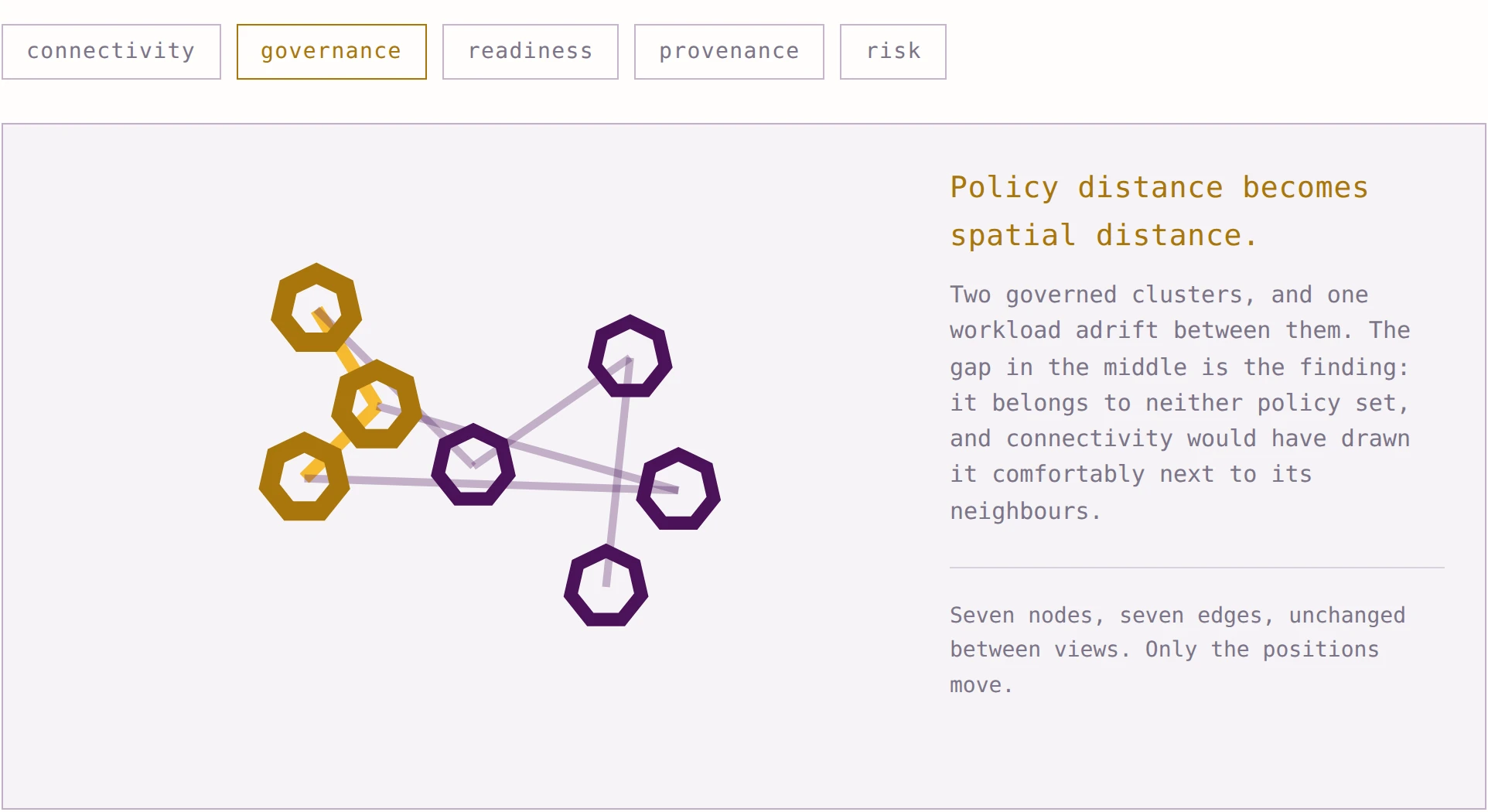
Agent Scope draws an agent system — the agents, their policies, gateways, data sources and the workloads they act on — as one set of nodes and edges, and lets the viewer choose what anchors the layout. Ten projections ship: eight built in, and two that a Kubernetes profile contributes at runtime, which the client has never heard of and does not need to. Each link carries a small envelope of values the control plane already knows, such as policy compatibility, trust, readiness and provenance, and every value also drives its own visual channel, so one link can read as well governed and poorly provenanced at the same time.
Questions asked in words are answered by issuing real read commands against the live cluster — pods, events, logs, nodes, namespaces — and reporting what came back, not by inferring from the prompt. Asked which pods in a namespace were not ready, it named six, and kubectl showed the same six.
Mutations pass an admission gate first. In the recorded run, scaling a standard-tier workload from 2 to 4 replicas was admitted and reached the cluster; the same request against a critical-tier workload was refused, and its replica count stayed at 3. The only difference was a label on the resource, so the decision is made on data rather than in code. A mutation needs a proof-of-admission token that only the gate can construct; a request no rule matches is refused; and allows and denials alike leave a decision artifact with the rule, the reason and a trace id.
Seven demos put the same gate and the same decision record in front of a different agent in a different domain. Each was recorded from the running system and archived on Zenodo, and each has its own live site and its own entry in this portfolio, listed below.
Everything described here runs and is measured on a real cluster: the projections, the read commands, the enforced gate and the decision artifacts, kept on a hash-chained ledger that survives a restart. The site publishes that status row by row, and the next step, reading policy from a cluster resource, goes through the one seam where policy is already assembled. The trace view in the gene-agent and ops-agent demos is the published @agent-scope-ca/graph-canvas component, available on npm.
Use cases
Gene agents + a quantum capabilityGene agents that hold their own policy
Three agents read real clinical-evidence records for EGFR, TP53 and BRCA1. Each holds a versioned policy file and reaches a quantum capability only through a gateway.
InfrastructureAn ops agent that asks before it acts
An operator gives orders in chat. The agent asks a gate that holds a policy file, makes the one call the gate admits on a live Kubernetes cluster, and reads the cluster back.
Software deliveryAgents propose, a gate decides
A coding agent’s change is tested, approved by a person, promoted and run once; an operations agent’s calls are decided before they reach the service. Measured beside cosign and Kyverno.
Laboratory dataAgentic LIMS: every result traced, every use decided
Public lab results held as an agentic dataset over MCP. An agent assembles a report; the dataset decides each result under its policy, a person approves what it escalates, and answers from method documents are checked quote by quote.
GPU fleetMassive GPU: simulated fleet, real control path
1,125 simulated nodes and 1,000 simulated GPUs on a real Kubernetes, beside a real GPU serving a real model. A gate decides each proposed change, a person approves what the rules send to one, and every step is in a hash-chained ledger. Recorded with the faults planted to test it.
Data estateSemantic Gateway: one estate behind one gate
Seven packs built from public sources and four ontology packs, 17,257 documents in all, linked only where evidence supports a link. One query is routed across them, each caller gets only what the policy admits, a person approves full reads, and every request is in a hash-chained ledger.
DocumentsSemantic Gateway for PDFs: every value on its page
118 public PDFs from NIST, FDA and EMA, read into typed fields by declared rules, with a model only for what the rules miss. Each value opens boxed where its page states it, the documents form a knowledge graph, and every request passes the same gate.
agentscope.caAgent Scope on LinkedIn@agent-scope-ca/graph-canvas