Pseudo: coding practice in Python or in blocks, judged on cases the solver never sees
A solution counts here when it is right on inputs it never saw and grows the way the task expects, not when it matches the examples.
A coding-practice app with 400 tasks in 19 groups, solved in Python or built from blocks that show the Python they make. A public demo lets anyone browse the tasks and write solutions; a judging server runs each submission in a sandbox and scores it against cases it keeps to itself.
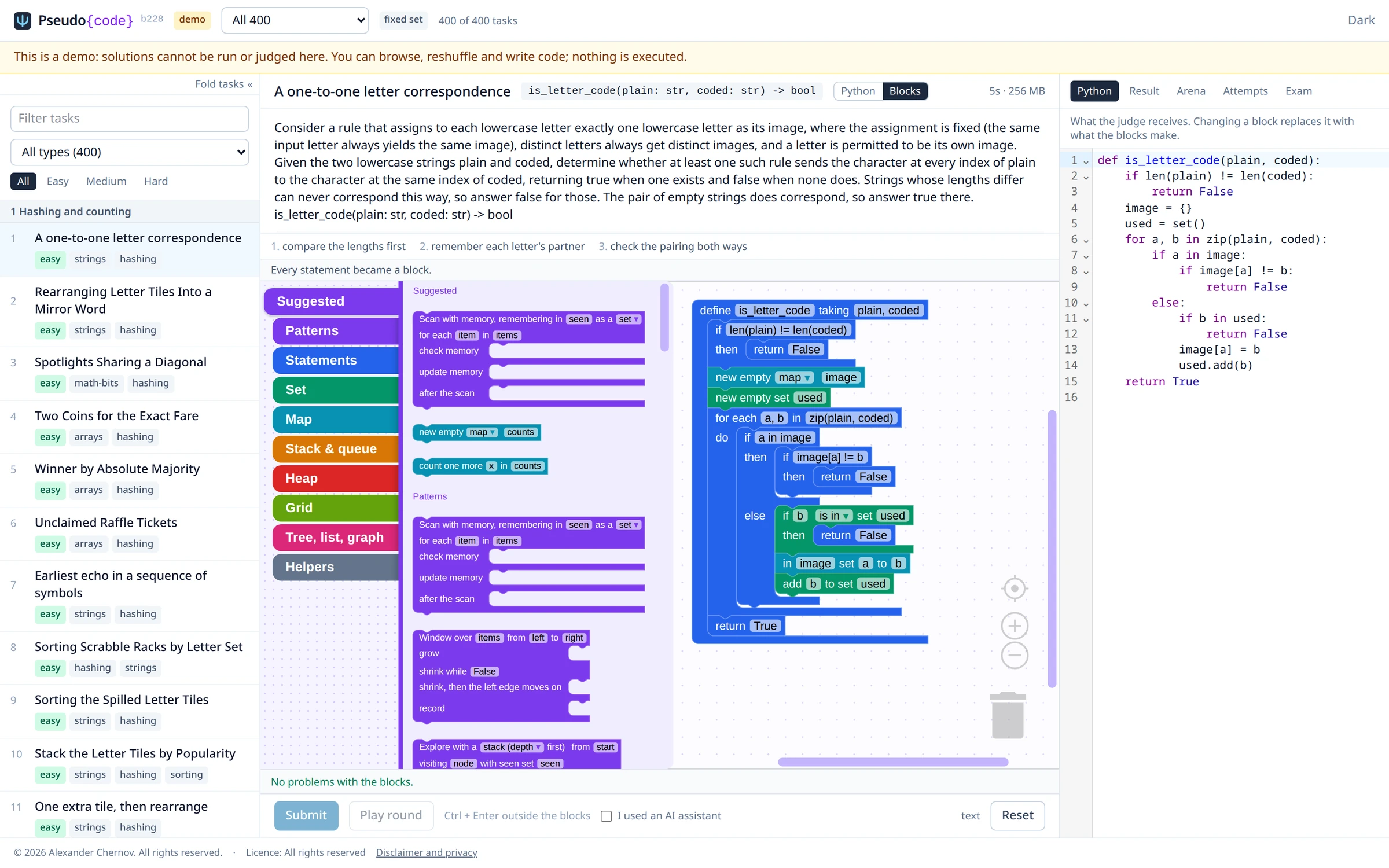
The public demo at pseudo.chernov.ca carries all 400 tasks, each with a statement, a signature and worked examples, grouped by technique from hashing and two pointers through trees, graphs and dynamic programming to class design, randomness and questions without code. Exams narrow the list to a set, and a reshuffle draws a new one. A solution can be typed in Python or assembled from blocks: the blocks write the Python beside them, and Python already written can be turned back into blocks. The public demo does not provide free access to the judging server, so nothing written there is run or judged.
On the judging server, every submission runs in its own throwaway gVisor container with no network and a read-only root, under time and memory limits. Before it runs, a static read rejects code that reaches for the network, the file system or dynamic evaluation, and catches a “solution” that is a table of the answers. It is then run on hidden cases generated from a reference solution, which never leave the server, so code that fits the visible examples but not the task fails.
Passing is not the whole verdict. The judge times the solution inside the sandbox at sizes that grow by a fixed factor and reads the growth as one of six classes, from constant to cubic; a correct solution that is too slow for the task, fails on a large input or goes over its memory budget is accepted with a flag and a lower score. The submitter sees how many cases passed, which kind of case failed, how slow it was and the complexity reading, but never the hidden inputs or the expected values, because those would let a solution special-case them.
Each user’s exam is derived from the user and the exam: 20 to 30 percent of the tasks, balanced by difficulty, with held-out cases kept for the final attempt. A second mode, the arena, answers the code with inputs: each family of inputs is a column, and the adversary picks the one the submission handles worst. Sign-in is through GitHub with read-only profile access, a submission made with an AI assistant is marked as such, and a capacity gate in front of the sandbox admits a submission, holds it in a bounded queue, or refuses it with a time to retry.