Reproducible spectral scoring with a fit-quality gate
A gate decides whether a score may exist — two spectra fit equally well, R² 0.998 and 0.999. One scores 100, the other 42.6.
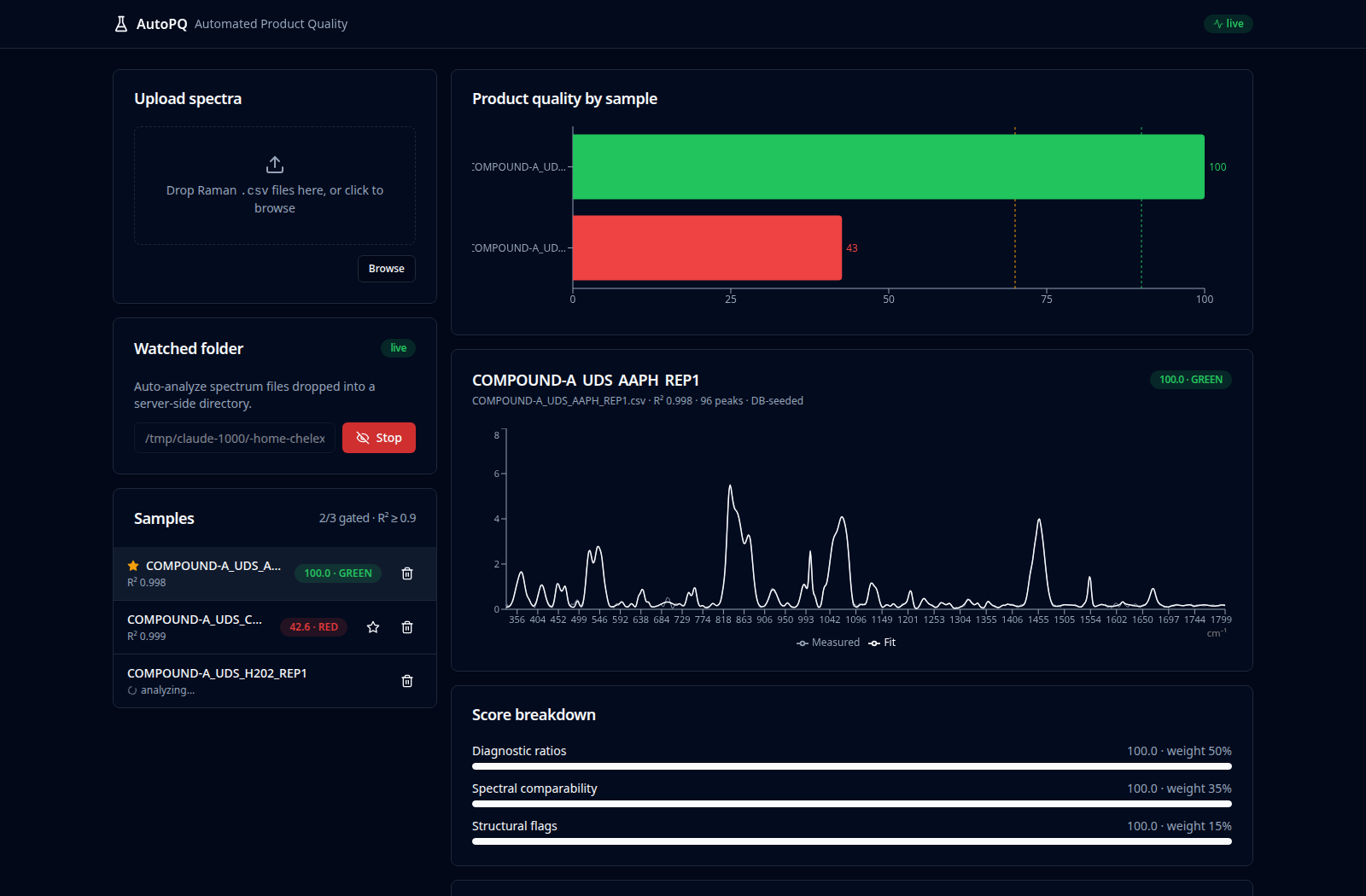
Spectral scoring done in notebooks is not reproducible across analysts, and the reasoning behind a score is not recoverable afterwards. This is a scoring loop with model, thresholds and provenance pinned, covered by 41 tests, plus a browser-native build running the same Python engine in-page through a Pyodide worker — the port reproduces the native reference exactly.
The finding is the part worth carrying anywhere. A post-fit rescaling step matched each component to the data independently, ignoring overlapping neighbours; in dense spectra the rescaled components summed to about 35 times the data. Shape correlation still read around 0.9, so every visual check passed — while R² had collapsed to −608 and every derived ratio was untrustworthy, with nothing reporting an error. The underlying fit had been correct all along.
A quality metric that measures only shape will not notice a magnitude error. Two checks that fail differently are worth more than one check that passes twice. The fix adopts the rescaling only when it does not worsen the residual: R² −608 to 0.98.
No public URL — internal system.