Selective visual inference with observable decisions
The descriptor decides whether to look again — and the decision, not only the detection, is what gets recorded.
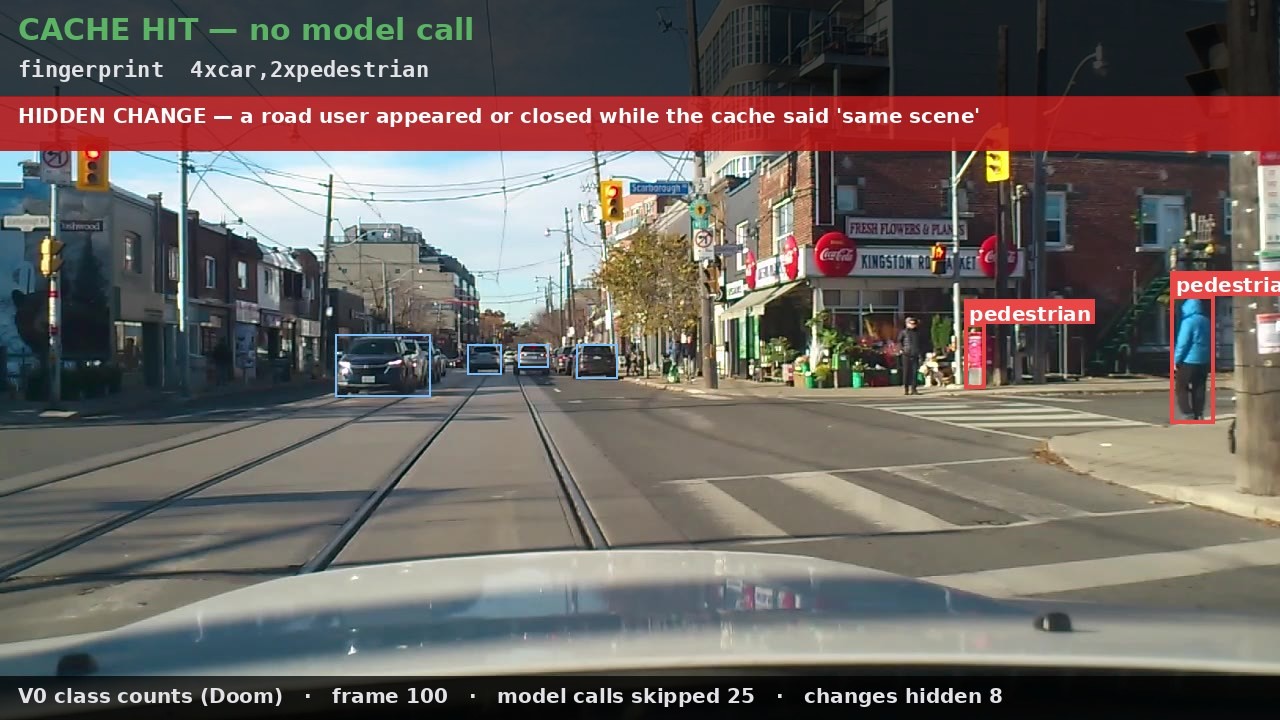
Vision models are normally run on every frame. That is the safe default and an expensive one. The narrower question is whether a cheap scene descriptor can decide when the previous interpretation still holds, and whether the cost of being wrong about that can be measured rather than assumed.
Across 1,712 contiguous dashcam frames at 5 Hz, a class-count descriptor skipped 43.6% of candidate model calls and left 28.5% of material scene changes without refreshed perception. Adding spatial and scale information brought the second figure to 9.1%, and cost reuse to do it. The result worth reporting is not a single optimum but that the tradeoff is measurable, which turns scene representation into an explicit engineering parameter rather than an implementation detail.
A second, independent detector evaluates the same frames, so the measurement does not rest on the detector that also defines the state being evaluated. The two disagreed about the presence of vulnerable road users on 9.5% of frames. Neither is ground truth — both are detectors — so that figure is disagreement, not an error rate, and it is reported as such.
Stated on the site rather than left to be discovered: no vision model is invoked in the measurement itself. The replay determines when a call would occur and what deferring it costs. Nothing here has been validated for use in a vehicle.
Transferable principle: a cache that hides a state change is not a performance question but a governance one, and the reuse decision has to be observable before anyone can argue about it.